Welcome. Our IB Computer Science Tutor Actually Sits Beside You.
One-to-One Online IB Computer Science Tutor. Founded in 2017.
If you are reading this, you are likely an IB Computer Science student who has felt that uncomfortable silence in a classroom – the one where the teacher explains a concept, everyone nods, and then you are left alone with a blank screen and a blinking cursor.
Or perhaps you are a parent watching your child spend hours on a single programming error, frustrated and convinced they are “just not good at coding.”
Book Your Free Diagnostic Session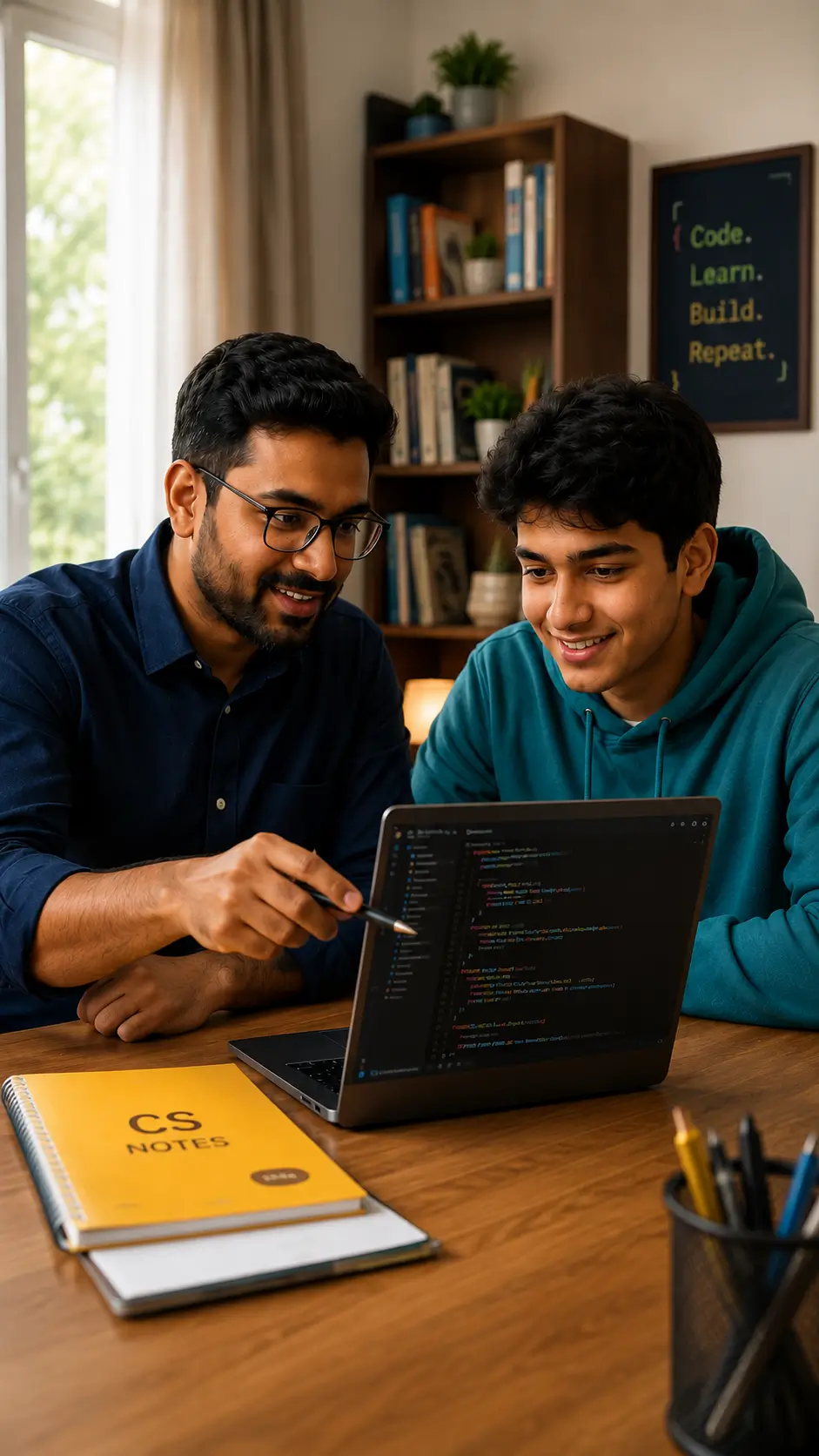
Observation By Our IB Computer Science Tutor.
We want to tell you something clear and honest: That frustration is not a reflection of your ability. It is a reflection of how computer science is taught.IB Computer Science is not like other subjects. You cannot memorize your way through it. You cannot read a textbook once and expect to write a working binary tree traversal. You have to do it. You have to trace it. You have to break it, fix it, and break it again. And in a classroom of twenty or thirty students, a teacher cannot sit beside every single child while they work through that messy, invaluable process.
That is exactly why Our IB Computer Science Tutor exists.
We are a small, dedicated academy that has been offering One-On-One Online IB Computer Science Tutor since 2017. We do not record pre-packaged video lessons. Our IB Computer Science Tutor does not put you in a Zoom room with six other students, all at different levels. We sit next to you – physically, in the same room – and we work on your problem, at your pace, until it makes sense.
We are not the biggest tutoring service. IB Computer Science Tutor has never been the loudest. But we are the ones who will patiently trace that fifth recursive call with you for the third time, without making you feel rushed or inadequate. Because we know that is what actually works.
What Keeps IB Computer Science Students Up at Night?
Before we tell you what IB Computer Science Tutor does, let us acknowledge what you are probably going through right now. These are not hypothetical scenarios – these are the exact conversations we have had with students almost every week since 2017.
📝 The Pseudocode Trap
Your school teaches you Python. You get comfortable. You can write loops, functions, and even classes. Then you open an IB past paper and see something like this:
It looks familiar, but not quite. You write your answer using Python-style syntax, and your teacher marks it wrong. You understood the algorithm perfectly – you just used the wrong notation. That is not a knowledge gap. That is a translation gap. And it costs students 3–5 marks in every exam.
😰 The IA Panic
The Internal Assessment is worth 20% of your HL grade and 30% of your SL grade. It is a massive project. But most students choose a project that is either embarrassingly simple (a calculator app that cannot possibly score high marks) or impossibly complex (an e-commerce site with payment integration that they will never finish in 30 hours). The scoping phase is where everything goes wrong. And once the scope is wrong, no amount of late-night coding will fix it.
🌀 The Recursion Wall
Recursion looks beautiful when your teacher traces it on the board. But when you sit down to write your own recursive function – say, to count the nodes in a binary tree – you get lost in the call stack. You forget the base case. You use the wrong return value. You end up with a RecursionError or, worse, a program that runs but produces garbage output. You stare at it for an hour and cannot see the error because your mental model of the call stack is slightly incorrect.
📚 The OOP Vocabulary Barrier
Object-Oriented Programming is not just about writing classes. IB expects you to use precise terminology: encapsulation, inheritance, polymorphism, aggregation, and composition. You might write excellent code, but when the exam asks, “Explain the relationship between the Library class and the Book class,” you write “Library has books.” That is correct in plain English, but the examiner was looking for “aggregation” because books can exist independently of the library. That one word costs you two marks.
📂 The File Handling Nightmare
File I/O looks simple in a textbook. open(), read(), write(), close(). But when you actually try it, you open a file in write mode by mistake, try to read from it, and get an UnsupportedOperation error. Or you forget to close the file, and when you try to open it again in the same program, you get a permission error. These are not difficult errors – they are frustrating errors. And when you are already anxious, a cryptic error message can completely derail your confidence for the rest of the session.
⚡ The HL Depth Problem
If you are an HL student, you face an additional layer of pain. You need to understand abstract data structures (stacks, queues, linked lists, binary trees), algorithmic efficiency (Big O notation, time complexity, space complexity), and deeper OOP concepts. These topics are not just “more content” – they are conceptually different. They require you to think about memory, about performance, about how data is organized at a fundamental level. A single misunderstanding in binary tree traversal can make every subsequent problem impossible to solve.
We mention all of this not to overwhelm you, but to tell you that our IB Computer Science Tutor has seen every single one of these problems and knows exactly how to fix them. We have been fixing them since 2017. And we do it One-On-One Online, one student at a time.
How Our IB Computer Science Tutor Actually Teach (The One-On-One Online Difference)
Our IB Computer Science Tutor does not have a fixed curriculum. We do not have a “Module 1, Module 2” structure that every student must follow. We believe that is rigid and inefficient.
Step 1: You bring your current problem.
It could be a worksheet from school. It could be your half-finished IA project. It could be a past paper question that you got wrong. It could be a program that crashes, and you have no idea why. We do not care what it is – we ask you to share your screen or open your laptop and show us where you are stuck.
Step 2: We find the exact gap.
IB Computer Science Tutors do not re-teach the entire chapter. We ask you to explain your thought process. We watch you trace the code. We ask: “Why did you write this line? What did you expect to happen?” Very often, the error is not in the code itself – it is in your mental model of how the code executes. We find that exact point where your understanding breaks, and we start there.
Step 3: We fix it together, on paper first.
Here is a secret that most coding tutorials do not tell you: You should never start by typing code. You should start by drawing a trace table, writing pseudocode, or sketching a diagram of what needs to happen. We force you to slow down. We make you write the steps on a piece of paper. Once the logic is clear on paper, the actual code writes itself in less than two minutes.
Step 4: You teach it back to us.
This is the most important step. After we have worked through the problem, we ask you to explain the solution to us – as if we were the student. If you can teach it clearly, you have truly understood it. If you hesitate or stumble, we go back to Step 2. This is not a test; it is a diagnostic tool. And it is the single most effective way to make sure you never forget the fix.
Step 5: You leave with a concrete artifact.
Every session ends with something tangible – a corrected piece of code, a filled-in trace table, a scoped IA plan, or a set of revision notes tailored to your specific weak areas. You do not leave with a vague “I feel better.” You leave with a file you can submit, a plan you can execute, or a concept you can now explain from scratch.
What our IB Computer Science Tutor Offers (Broken Down Clearly)
Our IB Computer Science Tutor does not believe in jargon or confusing packages. Here is exactly what we help with, in plain language:
IB Computer Science HL (Higher Level) Support
- Recursion: Tracing recursive calls, writing base cases, understanding the call stack, and debugging infinite recursion.
- Abstract Data Structures: Stacks, queues, linked lists, and binary trees – not just definitions, but actual implementation and traversal algorithms.
- Algorithmic Efficiency: Big O notation, time complexity, space complexity, and comparing different algorithms for the same problem.
- Advanced OOP: Deep dives into inheritance, polymorphism, aggregation, and composition – with real-world code examples.
- System Fundamentals and Computer Organization: Microprocessors, primary memory, secondary storage, and how they affect program performance.
IB Computer Science SL (Standard Level) Support
- Core Programming Fundamentals: Variables, data types, conditionals, loops, arrays, and basic input/output.
- Computational Thinking: Breaking a problem into steps, planning a solution before writing code, and debugging systematically.
- Algorithms and Pseudocode: Writing and tracing algorithms in strict IB pseudocode notation – we focus heavily on the translation from real languages (Python/Java) to IB-approved syntax.
- Networks and Computer Systems: Understanding how data moves across networks, IP addresses, protocols, and answering the theory questions accurately.
- Object-Oriented Programming (SL level): Classes, objects, encapsulation, and basic inheritance – explained with clear, visual examples.
IB Pseudocode Mastery (For Both HL and SL)
This is one of our most requested services. We do not assume you already know IB pseudocode. We start by translating your existing Python or Java knowledge into the IB format, side by side. We practice with real past-paper questions. We show you exactly how examiners mark pseudocode answers so you never lose marks on notation again.
Object-Oriented Programming (OOP) Clarity
We have a simple rule for OOP: If you cannot explain the relationship between two classes using the correct IB term (inheritance, aggregation, or composition), you have not understood it yet. We spend the time to make those distinctions crystal clear – not through definitions, but through actual code examples and diagrams.
Internal Assessment – Scoping & Planning
We do not write your IA for you. Instead, we offer structured guidance at every stage. Here is how we help you get started right:
- Scoping: We help you choose a project that is ambitious enough to score high marks but small enough to finish in 30 hours. We veto ideas that are too big or too small early on.
- Success Criteria: We help you write clear, testable success criteria that align with the IB rubric.
- Planning and Development: We review your approach, suggest efficient algorithms, and help you break the development into manageable weekly milestones.
Internal Assessment – Testing & Evaluation
- Testing and Evaluation: We teach you how to write a test plan, select test data, and evaluate your product against your success criteria.
- Video Recording: We guide you through the screen-recording requirements – what to show, how to narrate, and how to keep it within the time limit.
Our IB Computer Science Tutors have guided hundreds of students through the IA process, and we know exactly which stages cause the most stress. We focus our support on those exact stages.
Why 2017 Matters (Our Story, Briefly)
We started teaching IB Computer Science One-On-One Online in 2017.
Back then, IB Computer Science tutoring was not as popular as it is today. There were far fewer tutoring options. Students who struggled were often told to “just read the textbook” or “practice more,” without any specific guidance on how to practice.
Over the years, our IB Computer Science tutors have taught through multiple syllabus changes. We have seen the removal of Paper 3, the integration of the Case Study into Paper 1, the redesign of the IA, and the shift towards more pseudocode-based questions. We have adapted our teaching methods every single time.
We have taught students who had never written a line of code in their lives. We have taught students who could already build full-stack web applications but could not write IB pseudocode to save their lives. We have taught HL students who were terrified of recursion and SL students who were overwhelmed by basic arrays.
Every single one of those students improved – not because we are brilliant, but because we did one thing consistently: IB Computer Science Tutor listened to what they were actually struggling with and taught exactly that, in exactly the way they needed to hear it.
We are not an impersonal online platform. We are a small team of teachers who have been in the trenches with IB CS students for over seven years. That is the experience we bring to every session.
A Note on Honesty and Realistic Expectations
We want to be very clear about something.
Our IB Computer Science Tutor cannot guarantee you a perfect 7 if you only attend two sessions. That would be dishonest.
What we can guarantee is this: In every single one-on-one online session you have with us, you will fix at least one specific, concrete misunderstanding. You will leave that session with a working piece of code, a correctly traced algorithm, a perfectly scoped IA plan, or a set of revision notes that actually address your weak areas.
We do not sell you dreams. We sell you clarity.
- We do not provide last-minute “crash courses” before exams and promise miraculous results. We strongly recommend regular weekly sessions, so concepts have time to settle in your mind.
- We do not cater to students who want us to “do the IA for them.” If you are looking for someone to write your code, we are not the right fit. If you are looking for someone to teach you how to write your own code, then we are exactly what you need.
- Our IB Computer Science Tutor does not pressure you into long-term contracts. You can book one session, five sessions, or ten sessions – entirely based on how useful you find the first one.
Frequently Asked Questions (From Real Students and Parents)
Q: My school teaches Java, but I am more comfortable with Python. Does that matter?
A: Not at all. The IB syllabus does not mandate a specific language for teaching. We adapt our teaching to the language your school uses. However, we will also train you in IB pseudocode separately, because that is what the exam uses.
Q: What if I am a complete beginner and have never coded before?
A: That is perfectly fine. We have taught many students who started from absolute zero. We will not place you next to an advanced student and make you feel inadequate. We start with variables and conditionals, and we move at exactly your speed.
Q: How do you handle HL and SL students differently?
A: SL students focus on core programming, basic algorithms, and introductory OOP. HL students go deeper – they work on recursion, abstract data structures (binary trees, linked lists), algorithmic efficiency (Big O), and more complex problem-solving. We never mix both levels in the same session; every session is tailored to your specific level.
Q: Can you help with the Group 4 Project?
A: Yes, we can guide you on the Computer Science-specific aspects of the Group 4 Project, particularly the computational solution you need to build. However, your school’s science teachers will handle the overall assessment and integration with other subjects.
Q: Do you offer any materials or worksheets?
A: Yes. We do not rely on a single textbook. We curate our own worksheets, past-paper compilations, and tracing exercises based on your specific weaknesses. We share these with you during and after the session so you can practice independently.
Q: My child is a procrastinator and leaves everything to the last minute. Can you help?
A: We have dealt with many procrastinators! The most effective approach with procrastinators is not to lecture them – it is to set small, achievable weekly milestones for their IA or revision, and then hold them accountable in a gentle, supportive way. We break the work into tiny pieces so it never feels overwhelming. That reduces the urge to delay.
Q: What is your cancellation policy?
A: We ask for 24 hours’ notice for cancellations. If you cancel within 24 hours, we will charge 50% of the session fee. If you cancel on the day of the session without prior notice, we charge the full fee. We are flexible in genuine emergencies – contact us.
Pricing – Straightforward and Transparent
We believe in clear, upfront pricing. No hidden costs, no mandatory packages.
Package Discounts:
Book a block of 5 sessions and get 5% off the total. Book a block of 10 sessions and get 10% off the total.
We do not force you into a package. You can start with one session, and if you find it valuable, you can upgrade to a block later.
Payment: We accept bank transfers, UPI, and cash for One-On-One Online sessions. We will send you a receipt after every payment.
How to Get Started (In Three Simple Steps)
Book Your Free 30-Minute Diagnostic Session
This is a no-obligation conversation. You bring your most recent assignment, a past paper you struggled with, or even a code snippet that crashes. We spend 30 minutes working on it together, live, One-On-One Online. We point out the top three gaps in your understanding and fix the first one right there.
Decide If We Are a Good Fit
After the diagnostic session, we will suggest a learning plan – how many sessions we think you might need, what topics to prioritize, and whether we recommend weekly or bi-weekly sessions. There is absolutely no pressure to continue. If you feel even a small shift in clarity, you can book your first regular session.
Start Your Regular Sessions
We schedule a fixed time slot every week. You bring your school work, your IA, or your past papers. We work through them systematically. We keep a running log of topics covered and gaps remaining, so every session is purposeful and progressive.
A Final Word – For Students and Parents
To the student reading this:
Feeling stuck in IB Computer Science does not mean you are “bad at it.” It means you are learning something that requires a very specific kind of thinking – the ability to break a problem into tiny, logical steps and then translate those steps into a language a machine can understand. That thinking takes time to develop. Everyone develops it at a different pace. There is no shame in needing someone to sit with you while you trace that recursive call for the third time.
Your teacher has twenty other students. We have only you, for that one hour.
To the parent reading this:
We know you are investing your time, money, and trust in us. We take that seriously. We will never waste your child’s time with generic lectures or repetitive content they already know. We will identify exactly what they need, deliver it, and show you measurable progress – not through fancy reports, but through your child coming home with a working piece of code, a completed worksheet, or a confident smile about their IA.
We started this academy in 2017 because we believed that one-to-one, face-to-face teaching was the only way to fix the gaps that classrooms leave behind. We still believe that today.
Ready to move from confusion to clarity With Our IB Computer Science Tutor?
Book your free 20-minute diagnostic session today.
Book Your Free Diagnostic Session on WhatsApp